Is it just me, or…? Everyday food questions, a little science, and something useful for dinner.
Why do washed beets still taste earthy?
Beets’ earthy flavor comes partly from geosmin, an aroma compound that beets can produce themselves. Washing removes soil but won’t remove all of that characteristic flavor. Roasting and flavor pairings may make beets more enjoyable; preferences still differ. [1] [3]
“Earthy” is a lovely word when you like beets. When you don’t, it can sound like a very polite way of saying dirt.
I love beets, but I think the people in the second group deserve a better answer than “you just haven’t had them cooked properly.” You might have. You might still dislike them.
So what are you actually tasting? A compound called geosmin contributes to that distinctive earthy aroma. It’s part of the beet’s flavor story, even after you wash it. [1]
What is geosmin doing in my beets?
Geosmin is associated with that familiar smell of earth after rain. Our noses are sensitive to it. Which helps explain why a small part of a food’s chemistry can make such a big impression. [2]
Here’s the part that sent me looking further: is the beet simply picking this up from the soil? Research published in 2003 supported the conclusion that red beets can make geosmin themselves. That gives us a more interesting explanation than “there must still be dirt on it.” [1]
Wash your vegetables, of course. Just don’t expect washing to turn a beet into a carrot.
Does everyone experience that earthiness the same way?
We don’t all enjoy the same flavors. One person’s favorite roasted vegetable can be another person’s least favorite bite. The existence of geosmin explains an important aroma; it doesn’t give us a complete explanation for every individual preference.
It also doesn’t make disliking beets a diagnosis. I wouldn’t leap from “this tastes earthy to me” to a story about a deficiency, a food intolerance, or something being wrong with your taste buds.
For this particular kitchen question, I’d start with curiosity. Is it the aroma? The soft texture? The sweetness? Those are different things to work with.
How can I make beets taste less overwhelmingly earthy?
Roasting is one option. University extension guidance describes it as a way to mellow their flavor and bring their natural sweetness forward. That doesn’t mean the earthy note disappears. [3]
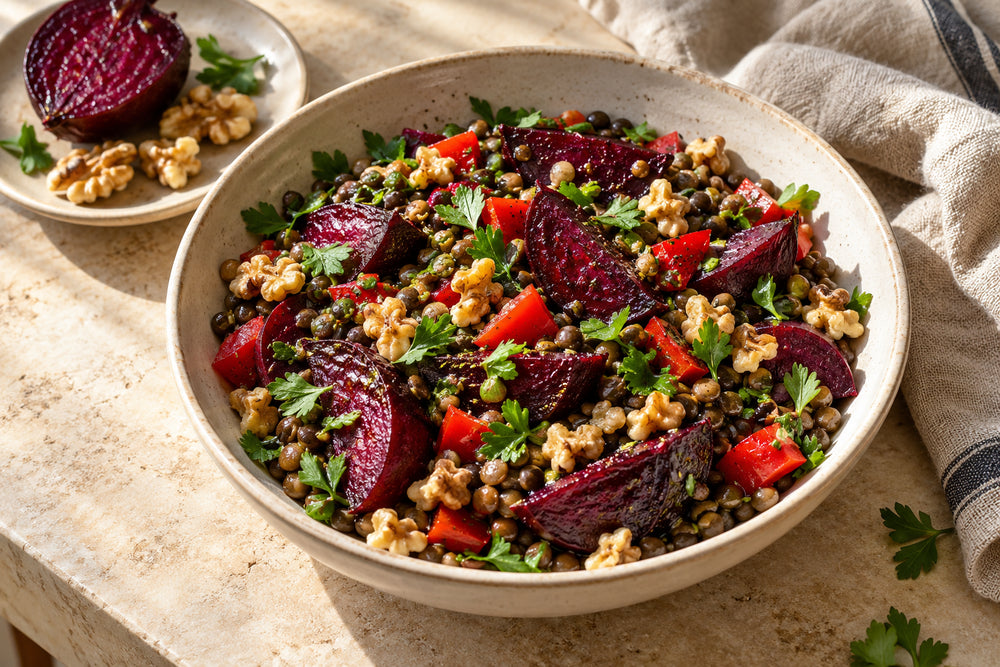
I’d give the beet a few interesting neighbors: something tangy, something crunchy, and an herb or spice you already enjoy. Think roasted beet wedges with lemon, walnuts, and cumin. Or small pieces alongside lentils, parsley, and red bell pepper.
Those are flavor combinations to try, not a promise that lemon or cumin will chemically remove geosmin. A dressing can change how a whole bite tastes without erasing the compound that started the conversation.
A tiny dinner-table experiment
Try three small bites from the same batch of cooked beets: one plain, one with a squeeze of lemon, and one with lemon plus a little toasted cumin. Keep everything else the same. Which tastes best to you?
That’s the engineer in me: change one thing, pay attention, and see what you learn. You don’t need a spreadsheet. Although I would understand.
If the answer is still “none of them,” that’s useful information too. There are plenty of other vegetables to enjoy.
Where this lands in my kitchen
Beet and walnut is a combination I love enough to use in our Roasted Beet & Walnut patties. The beet is meant to be part of the experience. Cook according to the pack directions and try it with a bright, crunchy side.
For the nutrition rabbit hole, there’s also our earlier look at beets, fiber, iron, and blood sugar research.
Which part of beets divides your table: the flavor, the texture, or those very committed pink stains?
For fellow rabbit-hole readers
- Lu et al. (2003), Biosynthetic origin of geosmin in red beets. Experimental evidence about the origin of geosmin.
- Colorado State University: February Food Feature—Beets. Earthy aroma and sensory context.
- North Dakota State University: A root to love. Beet flavor and preparation.